

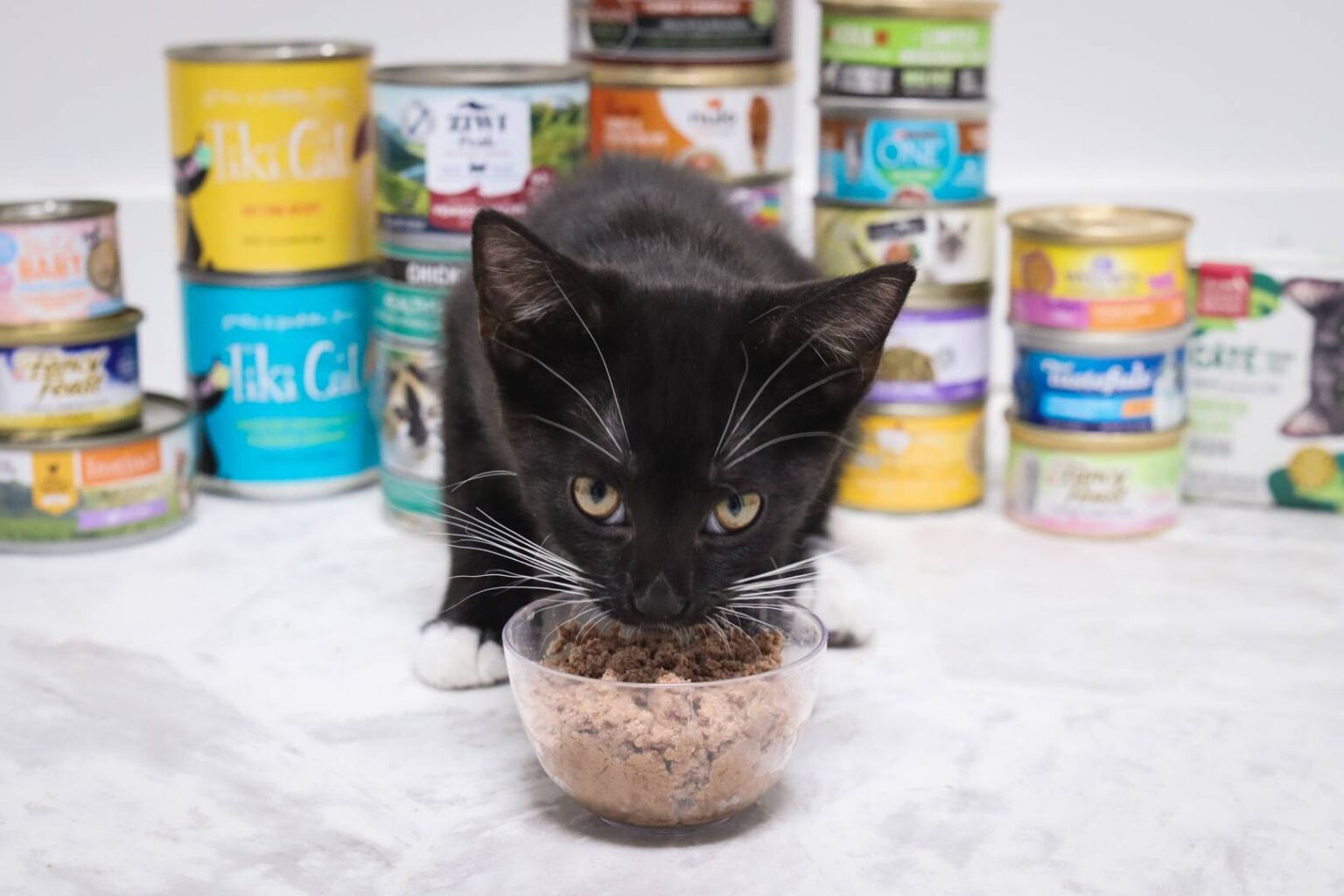
Kirsten McCarthy / Cats.com
French author Francois de la Rochefoucauld said that “to eat is a necessity, but to eat intelligently is an art.”
Feeding a cat looks simple enough at first glance. You buy a bag of food with a picture of a cat on it, dump it in a bowl, and wait for your cat to eat when they’re hungry. It’s an approach that can work, but it doesn’t always bring out the best in your kitten or cat.
Feeding your cat intelligently involves a little more care.
In this cat feeding guide, you’ll learn how to nourish your cat from kittenhood through their senior years. You’ll find out how much to feed your cat at different life stages, how many meals they need per day, and which types of food are best.
We’ve broken down your cat’s dietary needs by age group, giving you a roadmap for good nutrition at every stage of life.
Your Cat’s Dietary Needs Evolve Over Time
As your cat moves through kittenhood, early adulthood, and beyond, their nutritional needs will change. Meeting those requirements at every phase of life sets the stage for good health.
Your first stop when choosing the right food for your cat? The nutritional adequacy statement.
Usually located on the back of the bag or can, this statement indicates whether or not the food is nutritionally complete and balanced for its intended life stage. The label will read, for example, “…formulated to meet the nutritional levels established by the AAFCO cat food nutrient profiles for all life stages.”
Foods that aren’t nutritionally complete and balanced will usually be labeled “for supplemental feeding only.” These foods don’t contain the appropriate balance of macronutrients (protein, fat, and carbohydrates) and micronutrients (vitamins and minerals), and shouldn’t be your cat’s sole source of nutrition.
While you’re looking at the label, check out the feeding instructions, as well. For the average house cat, the appropriate feeding instructions are usually placed on the packaging of the cat food.
The nutritional guidelines on the package will point you in the right direction, though you might need to make some modifications to fit your cat’s exact needs.
Here’s a guide on how to feed your cat during the different phases of their life.
Newborn Kitten, Age: 0 to 4 Weeks
Kateryna Lekhner / Cats.com
During this stage, most kittens rely on their mother’s milk as their only source of nutrition. If their mother is present, you won’t need to feed kittens at all—they’ll know how to feed themselves! That said, if you’ve rescued an orphaned kitten, you’ll need to bottle feed.
Kittens require a kitten milk replacement formula, which replicates the nutrition found in mother cat’s milk. You can purchase kitten milk replacer from your veterinarian or from a pet-supply store. Do not feed a kitten cow’s milk—it doesn’t have the right nutritional balance to nourish a newborn kitten.
Kitten milk replacer might come as a powder, which is mixed with water according to the package directions, or as a ready-to-feed liquid formula. Ready-to-feed formula does not need to be mixed up, but it’s more expensive than powder formula.
Leftover reconstituted milk replacer can be stored in the refrigerator for up to 24 hours after which time it must be discarded. Once opened, ready-to-feed liquid formula can be stored in the fridge up to 72 hours, then must be discarded. Warm up cold formula that’s been in the refrigerator before feeding it to the kitten.
How Much Should You Feed Your Newborn Kitten?
If your kitten’s mother is available to nurse, the kitten will nurse freely. If you’re bottle-feeding, follow the instructions on your package of kitten milk replacer. Exact amounts might vary depending on the brand of milk replacer, but in most cases, you’ll feed about 2 tablespoons (30 milliliters) of liquid kitten formula per 4 ounces of body weight daily.
For example, a 2-week-old kitten weighing 8 ounces would get about 4 tablespoons (60 milliliters) of liquid kitten formula daily divided into equal portions across several meals. This might look like 10 milliliters of milk replacer formula six times a day or 7.5 milliliters eight times a day.
How Often Should You Feed Your Newborn Kitten?
Newborn kittens that are nursing from their mother feed frequently, latching on to nurse once every one to two hours. However, when bottle feeding, the kittens are receiving a larger volume of formula, so they don’t need to eat this frequently. Feed kittens ages newborn to 4 weeks old every three to four hours, or six to eight times per day. Very young kittens (newborn to 1 week old) or those that seem weak can be fed every two hours.
Cat Feeding Chart
| Age | Approximate Weight | Amount to Feed | Schedule |
| 0 to 1 week | 50 to 150 grams (1.7 to 5.2 ounces) | 2 to 6 ml kitten formula | Every 2 hours |
| 1 to 2 weeks | 150 to 250 grams (5.2 to 8.8 ounces) | 6 to 10 ml kitten formula | Every 2 to 3 hours |
| 2 to 3 weeks | 250 to 350 grams (8.8 to 12.4 ounces) | 10 to 14 ml kitten formula | Every 3 to 4 hours |
| 3 to 4 weeks | 350 to 450 grams (12.4 to 15.9 ounces) | 14 to 18 ml kitten formula | Every 4 to 5 hours |
| 4 to 5 weeks | 450 to 550 grams (15.9 ounces to 1.1 pounds) | 18 to 22 ml kitten formula Starting the weaning process; gradually switch to a mixture of kitten formula and wet kitten food | Every 5 to 6 hours |
| 5 to 8 weeks | 550 to 850 grams (1.1 to 1.5 pounds) | Weaning; offer an unlimited amount of wet kitten food | Every 6 hours |
| 8 to 9 weeks | 1.5 to 2.6 pounds | 250 to 360 calories per day | Every 6 to 8 hours |
| 9 to 10 weeks | 1.6 to 2.9 pounds | 250 to 360 calories per day | Every 6 to 8 hours |
| 10 to 11 weeks | 1.8 to 3.1 pounds | 250 to 360 calories per day | Every 6 to 8 hours |
| 11 to 12 weeks | 2 to 3.3 pounds | 250 to 360 calories per day | Every 6 to 8 hours |
| 12 to 13 weeks | 2.2 to 4 pounds | 250 to 360 calories per day | Every 6 to 8 hours |
| 13 to 14 weeks | 3 to 4.5 pounds | 250 to 360 calories per day | Every 6 to 8 hours |
| 14 to 15 weeks | 3.5 to 5 pounds | 250 to 360 calories per day | Every 6 to 8 hours |
| 15 to 16 weeks | 4 to 5.5 pounds | 250 to 360 calories per day | Every 6 to 8 hours |
| 4 months | 4 to 5.5 pounds | 60 to 65 calories per pound of body weight per day | Every 8 hours |
| 5 months | 5.1 to 6 pounds | 60 to 65 calories per pound of body weight per day | Every 8 hours |
| 6 months | 5.5 to 6.5 pounds | 60 to 65 calories per pound of body weight per day | Every 8 to 12 hours |
| 7 months | 6 to 7 pounds | 60 to 65 calories per pound of body weight per day | Every 8 to 12 hours |
| 8 months | 6.5 to 7.5 pounds | 60 to 65 calories per pound of body weight per day | Every 8 to 12 hours |
| 9 months | 7 to 8 pounds | 60 to 65 calories per pound of body weight per day | Every 8 to 12 hours |
| 10 months | 7.5 to 8.5 pounds | 60 to 65 calories per pound of body weight per day | Every 8 to 12 hours |
| 11 months | 8 to 9 pounds | 60 to 65 calories per pound of body weight per day | Every 8 to 12 hours |
| 12 months to adulthood | 8 to 9.5 pounds | 20 to 33 calories per pound of body weight per day | Every 8 to 12 hours |
Your Cat Needs Water, Too
In addition to the correct food regimen, it’s also important that a cat has access to clean water. Proper hydration helps to prevent constipation and reduces the risk of urinary system diseases like urinary tract infections and blockage.
Access to fresh water is essential, regardless of whether your cat eats dry or wet food.
Consult With Your Veterinarian for More Advice
Even with the knowledge shared in this article, you should consult with your veterinarian for your cat’s individual dietary needs. Your veterinarian will be able to recommend the ideal diet and feeding regimen for your cat based on your cat’s age, lifestyle, dietary preferences, and overall health status.
-
Guide to Raising Unweaned & Underage Kittens, UC Davis Koret Shelter Medicine Program. https://www.sheltermedicine.com/library/guidebooks/?r=guide-to-raising-unweaned-underage-kittens/caring-for-kittens-from-birth-to-eight-weeks
-
https://resources.bestfriends.org/article/bottle-feeding-kittens#Feeding